Showing posts with label academic. Show all posts

Tuesday, August 3, 2010

Maughan Library

The last library visit! A momentous occasion. While some of the group took the bus, others of us walked over to Chancery Lane to visit the Maughan Library, one of the libraries in the Kings College Libraries system. Sally, the Information Services Manager, greeted us and told us a little about the Library and the College. Kings College was founded by King George IV and the Duke of Wellington in 1829 and now consists of several campuses. We were visiting the Strand Campus. Before moving into its current facility in 2001, the Maughan consisted of 4 libraries, each crammed full of items. The move, into the former Public Record Office, allowed all the collections to be housed together. The building is fireproof (it was the first building in London to be built that way) but as it is a historic building, there were restrictions on renovations and use of space. When we toured the space we noticed the impact of this, including limited signage and areas of shelving that could not be used. The Library contains over 1300 seats (300 of them are at computers) and houses over 750,000 of the 1.3 million total volumes in the Kings College Libraries system. The Library serves the 11,000 students at the Strand campus, as well students from other Kings College campuses. In addition, the College has partnerships with other universities and also serves around 1,000 registered visitors. The move to the new building has allowed the Maughan Library to be open 7 days a week, and during exams the Library is open 24 hours a day.

On our tour of the building (I have never been through so many sets of doors in my life!) we saw a collection of short loan items, containing mostly law books, which students could check out for up to a day. Surprising, the Library also had a collection of DVDs and videos to support the film studies program, and any student could borrow from this collection. We also visited the Special Collections reading rooms. Special Collections consists of printed materials from the late 15th Century to the 21st Century. All items were closed access and had to be viewed in the 12 seat reading room. The librarian there showed us some items from the collection, including an illustrated book from a concentration camp, and a copy of a medical book that had recipes and astrological notes from its owner written inside. Fascinating.


Images courtesy of the King's College website.

National Archives of Scotland


For our final stop on our whirlwind Scottish libraries tour we went to the National Archives of Scotland. The National Archives is an agency of the Scottish government and has a staff of about 160 people. Its goals are "To preserve, protect, and promote the nation's records" and "To provide the best possible inclusive and accessible archive that educates, informs, and engages the people of Scotland and the world" (information from a presentation to our class). The Archives consists of 2 divisions, Record Services and Corporate Services, housed in 3 buildings. These buildings contain over 70 km of records. Records date from the 12th Century to the 21st Century and consist of such materials as taxation records, church records, maps and plans, government records, wills and testaments, and railway records. The Archives receives from 10,000-12,000 enquiries a year, quite a sizable amount! There is no charge for basic enquiries, but due to the amount of requests, staff are not able to do research for enquirers, only point them in the right direction. Extra services, such as looking at or printing digital records, requires payment. Archives staff also maintain 8 websites. Websites include the Scottish Archive Network, the Scottish Register of Tartans, and the National Register of Archives for Scotland as well as the online catalogue, containing over 3 million records.

The original building housing the Archives, the General Register House, was opened in 1847 and now functions at the ScotlandsPeople Centre, where people can trace their family history. The Archives grew at a rapid pace and required more space. The West Register House opened in 1971 and the Thomas Thomson House opened in 1994. The Archives are also constantly updating their services. The online catalogue is being updated to contain all items, the Church of Scotland records, valuation rolls, and other items are being digitized, and the ScotlandsPeople Centre has been formed. At this point I wished I had some Scottish blood in me so that I could trace my family history (maybe I do and I just do not know it).

We also went on a guided tour of the Archives, where we were saw the fabulous Robert Adams Rotunda in the center of the building (the General Register House) and some interesting mobile shelving. Upon our return to our presentation room, we were able to look at some of the items in the Archives. I looked at a cookery book and a letter that had words going all directions, so as to maximize the use of the paper. A few of us became fascinated (perhaps too fascinated) by an outpatient record book and puzzled over some mysterious ailments contained in its pages. All in all a very interesting visit.

Dunfermline Carnegie Library


Well, I am sorry to say that I have returned from my trip. There was so much happening at the end, what with the mini-break and trying to cram everything into the last few days in London, that I got a little behind in the library blog entries. Along with the following entry, I will have two additional entries.

The Dunfermline Carnegie Library, part of the 52 branch Fife Libraries system, is the first of over 2,500 Carnegie libraries in the world. This library is part of the focus for my research paper, which will compare the first Carnegie to a Carnegie in the United States.

The Dunfermline Library officially opened on 29 August 1883 in Andrew Carnegie's hometown (visitors interested in Carnegie's life may stop by the nearby Andrew Carnegie Birthplace Museum). It was such a success that it ran out of books on the first day! The Library has continued to be popular and has required additions to be built to add more space. A children's room was added on in the 1930s and another addition was constructed in the early 1990s. A museum and art gallery will be added in the near future.

Before our tour I took the opportunity to wander around the Library by myself. The Library used the Dewey Decimal System, and, like other UK libraries, had headings above each section to note their contents. Interestingly, I did not notice any DVDs in the building and later learned that they were not carried at the Dunfermline Library but were available for request from other libraries in the system. After my self-guided tour of the ground floor, our class met up again and we were split into two groups. My group's tour guide, Stephanie, showed us around the Library. In addition to the main lending area and the children's room, the Library is also home to a local and family history room, a reference room, and a special collections room. The local and family history room contained such items as ordnance survey maps, valuation rolls, council minutes, and photographs, all catalogued separately from other Library materials. We were given the opportunity to see the closed stacks area, where more valuable materials are kept. We then moved on the the reference room, part of the original Library structure. Next door to this room was the special collections room, not originally intended for that purpose, and only opened by appointment. In this area was the Murison Burns Collection, containing books and memorabilia about Robert Burns collected by the Scot John Murison.

At the end of the tour we were very kindly served refreshments and had the opportunity to talk further with our guides. I very much enjoyed the Dunfermline Library. I look forward to learning and writing more about this library in my research paper.

Tuesday, July 27, 2010

Edinburgh Central Library


Next up on our Edinburgh library tour was the Central Library, part of of the Edinburgh City Libraries and Information Services. The Central Library, a Carnegie Library, opened its doors in 1890 and has more than 850,000 items in its collections. I was really excited to be able to visit a Carnegie (I used to work in a couple of them in the States) and I wandered around a bit before the tour began. The Library is made up of several libraries, including the Central Lending Library, the Fine Arts Library, the Reference Library, the Scottish Library, the Children's Library, and the Music Library. (The Children's and Music Libraries are housed in a a separate building). I found the most interesting area to be the one-room Central Lending Library. The room was majestic with its tall wooden shelves and natural lighting. I noticed a collection of Arabic and Chinese books as well as a collection of Quick Reads books, a line with which I was unfamiliar. Quick Reads turned out to be a line of short, easy to read books available in the UK.

After browsing I joined the rest of the group for a talk and tour of the Library. We first heard from the head of Virtual Library development. This library started less than a year ago and is both a portal for online information and a way to raise the Library's profile. It contains e-books, the Heritage Image Collection, and a "Your Edinburgh" community information site that contains links to local and national organizations, health information, as well as other information pertinent to users. I think this is a great way to reach out to users and provide a portal to useful services. The Library also runs a blog and and a Twitter page to connect with the public.

We heard from the head of special collections (containing materials from the 15th century to present) and members of the Reader Development department. The purpose of reader development is to engage with readers to find out if users are satisfied with Library services. They also co-ordinate author events, book groups, staff training programs and other events. Currently, there is a rather interesting summer reading promotion called "Take a Break With a Great Scottish Book." While we have similar departments in the States, this seemed like a great way to keep in touch with users.

I really enjoyed my visit to this library. The staff were kind enough to provide us with refreshments and made us all feel very welcome. Thank you so much!

Photo courtesy of Edinburgh-Scotland.net.

National Library of Scotland

Hello! I have been away for a few days in Scotland (mainly Edinburgh) for a mini-break and am only now getting caught up on the blog. Before the break began our class visited a few Edinburgh libraries. The first was the National Library of Scotland in the center of Edinburgh Old Town. The Library grew out of the Advocates Library (established in 1689) and was only officially established in 1925 by the National Library of Scotland Act. Work began on the first building in 1938 but due to the interference of World War II, it did not open until 1956. As the Library is the legal depository library for Scotland, with 6,000 new items added every week, one building was not enough to house all of the collections. An additional building, the Causeway Building, opened in 1995. The collection consists of 14 million books and manuscripts, 2 million maps and atlases, 300,000 music scores, 32,000 films and videos, and 25,000 newspaper and magazine titles (collection information from the Visitor Centre). These materials comprise 490 languages. To view these materials users are required to register for a card. Registration is open to everyone, and cards are available for short-term use (3 months), or long-term (up to 3 years). Registration forms are available online.

Although we were not able to see any of the collection, we visited two exhibitions in the Visitor Centre. The first contained items from the John Murray Archive, acquired by the Library in 2006. The first John Murray began a book selling business on Fleet Street in 1768 and became an influential publisher. The archive contains materials from the firm's publishing history. I was excited to see letters and other paraphernalia from Arthur Conan Doyle, Charles Darwin, Sir Walter Scott, Lord Byron, David Livingstone, and others. The other exhibition contained golf memorabilia.


Friday, July 16, 2010

Bodleian Library

I got up bright and early (7:30) on 16 July to get ready for our trip to Oxford to tour the Bodleian Library. We started off our journey by taking the Tube to Paddington Station where I of course had to buy a bear (or two) and then we took the train to Oxford. This was my first experience on a UK train, and as it was rush hour it was unfortunately packed to the gills. I had to stand the entire way, about an hour, and also had to stand on the way back. Once we arrived in Oxford Dr. Welsh was kind enough to provide us with tickets for the sightseeing bus so that we could see the town. The town itself was beautiful; lots of old buildings housing colleges and churches.

Following a partial tour on the bus we alighted to make our appointment at the Bodleian Library, the biggest university library in the world. The Library was begun in the 14th century with only around 20 books. In 1439 Humfrey, Duke of Gloucester, donated 281 manuscripts from his own collection. While this might seem like a small number, for the Library it was a huge amount. Books were originally chained to the lecterns, and later, to the shelves, requiring a lot of space. The Library had to move to a new building to accommodate these new materials. Unfortunately, these books were destroyed during the Reformation and the space was left empty. Luckily, a man named Thomas Bodley came to the rescue.

Thomas Bodley was a world traveler and in 1598 he offered money and about 2,000 books to rebuild the Library. The new institution opened in 1602 and was named in his honor. While the Library was still rather primitive, electrical lighting and heat came centuries later, it featured shelves and chairs between the shelves, so that one no longer had to stand at the lectern to read. Books were chained to the shelves by their front covers. As this required the pages to face outward, the books were numbered on the pages and then recorded by number in the catalogue. In 1610 Bodley negotiated an agreement to get one copy of all published books for free. Presently the Bodleian Library has a partnership with the British Library, the National Library of Scotland & Wales, Trinity College, and Cambridge to receive all books published and share them between the group. The Bodleian receives from 3,000 to 4,000 items per week and has a current collection size of around 9 million items.

Students from Oxford University as well as any university in the world may apply for a reader's card. With a good reason members of the public may also apply for a card. As part of our tour, we went behind the scenes and looked at the book delivery system. Because the Library occupies more than one building, including the Radcliffe Camera, reader requests are received on a computer, then are fetched by staff, and are delivered using an automated machine. It takes about three hours to get a book through this system. Unfortunately, this delivery system will soon cease.

After emerging from the depths of the Library, we toured the Divinity School (take a virtual tour here) and Convocation House. The Divinity School was beautiful, with Gothic ceilings and interesting carvings. It was opened in 1488 and served as the school's first examination room. Andrea and I volunteered to go up to the pulpits and perform a mock examination. I was the student, and even though I did not know Latin, our guide pronounced that I had passed. Oral examinations could last up to 3 days and could be witnessed by other interested parties. It took 7 years to get a degree (1 year for each liberal art) and another 3 years to get a doctoral degree. The Divinity School was used as the setting for the infirmary in the Harry Potter films.

Thursday, July 15, 2010

National Art Library


On 15 July our class took a trip to the National Art Library at the Victoria & Albert Museum. The National Art Library is a public reference library with about two million items in its collection. The collection contains books and journals on all aspects of the arts and about 60% of the items are in a foreign language. Although it is a public library, readers must register before they look at materials (cards are valid for three years), and all items must be viewed in the reading rooms. Readers may look up their materials in the online catalogue, or get reference assistance at the enquiry desk. The Library also offers several e-resources, such as JSTOR.

As part of our visit we were given a special behind-the-scenes tour. Seven of us went first to see some special items that had been selected especially for our viewing. Included in these items were a Shakespeare First Folio from 1623, corrected proofs and serialized versions of Charles Dickens' Bleak House, and correspondence from John Edward Millais. I found the most interesting item to be what at first appeared to be an empty snow globe, but when shaken turned out to have words from the Pledge of Allegiance inside. The piece was from 1994. Our guide mentioned that because the collection is so large, the Library tries as much as possible to preserve rather than conserve and we saw several items that had custom archival boxes.

After viewing those treasures, we went into the stacks. With the exception of the archives, all of the Library's collections were on site. Due to the large size of the collection, items were housed everywhere, some above the regular museum collections, and others above the bookshelves or in cupboards. The two beautiful main reading rooms had books on the main floor as well as in galleries above. A third room featuring part of the museum's collection also had a gallery. Hidden from view were two floors of stacks. While items had call numbers attached, they were shelved according to size to maximize space. Requested items are fetched by one of the sixty members of staff every half an hour.

At the end of the tour we were free to leave. I stayed in the museum for about an hour, visiting the shop and the Medieval and Renaissance collections. Afterward I took the tube to Covent Garden to browse.

Photo courtesy of the National Art Library.

Stratford-upon-Avon Library & Information Centre


On the morning of 14 July (Bastille Day!), a few program classes boarded the bus for Stratford-upon-Avon. We arrived in the early afternoon and my class was free to take to the streets. A few of us headed for the town's library, the Stratford-upon-Avon Library & Information Centre. The Library is part of the Warwickshire Library & Information Service and is an original 1905 Carnegie library. As I have worked in Carnegie libraries in the past, it was interesting to note the layout and use of space of this particular building.

Library materials were housed on two levels, ground floor and first floor. The ground floor contained a main room with the circulation desk and public access computers. The layout of the desk was slightly confusing, with staff terminals on three sides, making it hard to figure out where to stand. The ground floor also included a CD room (£1/week for one CD and £2/week for multiple discs), another room with large print books and talking books, and an area with tourist information. In the large print and talking books room there was a glassed-in BBC Coventry & Warwickshire Radio room. It was unclear whether or not any broadcasting took place from the room. I also noticed a magazine area and a shelf with self pick-up holds.

Heading upstairs we found the main portion of materials. These included teen books, fiction, and nonfiction. Fiction books were shelved by author's last name and did not have spine labels, only a check-out stamp card in the front. Nonfiction books had call numbers and were shelved in Dewey order. At the end of the space were two additional rooms. One was a local history area, with microfiche readers and tables and chairs, and the other was a small children's room. The Library hosts rhyme time sessions every other Tuesday and a "Wiggle & Jiggle" event featuring rhymes, stories, and songs, on the fourth Wednesday of every month. Both events cost £1 per child. Also upstairs was an enquiry desk, unfortunately closed when we visited.

I continue to be amazed that UK libraries charge for some services. As I mentioned above, there were charges for children's activities and CDs. I also noticed that there is a charge to reserve materials and a £3.50 charge to obtain an item through interlibrary loan. Also noticeable was the use of CCTV. The circulation desk on the ground floor had a television that cycled through different views of the Library.

After roaming the town we were treated to a performance of Shakespeare's A Winter's Tale from the Royal Shakespeare Company. The theatre was intimate, I sat only a few rows from the stage, and although I was not familiar with the plot, the play was dramatic and very moving. Thank you to the program for providing us tickets.

Photo courtesy of the Warwickshire Library & Information Service.

Guildhall Library

After my visit to the City Business Library, I went up the stairs into the Guildhall Library, another City of London public library. I had learned on our group's earlier visit to the Barbican Library that the Guildhall Library had been founded in the 1420s by Dick Whittington. Like the City Business Library, the Guildhall Library is a reference only institution. I enquired at the information desk as to the size of their collection, but again the librarian did not know of any current statistics. She estimated that the collection contained few hundred thousand volumes. Most of these are not on public display, but are available to request through the Library's catalogue. Items stored on site may be fetched in around 15 minutes, but some may take up to two days. Most manuscripts are stored at the London Metropolitan Archives but several computers provide access to the City of London Digital Archive.

The Guildhall Library, like the City Business Library, was small but modernized. It contained several journals as well as books. Journal subjects varied but included archaeology, history, and current events. Books were divided according to subject, and had call numbers written on the spines. Areas represented included encyclopedias (such as Encyclopedia Britannica), finding aids (such as an index to the papers of the House of Commons), education, law, literature, the arts, and history. Also represented was a large collection on London. Interestingly, I noticed several travel guidebooks in this collection, including one about dogs in the city. A full list of items on offer may be found at the Library's website.

In addition to books and journals I also noticed an intriguing section of leaflets. These included information about how to find such information as hospital records or even police officer records. I also picked up what appeared to be the first edition of a new Guildhall Library newsletter. It can be found online here. It includes notes on new acquisitions, events at the Library, and recent Library improvements. What a great way to reach out to users.


Photo courtesy of Library Marginalia.

City Business Library

As part of our journal assignment, we are required to write an entry on each library we visit as well as three additional entries. For one of these additional entries, I visited the City Business Library, a public reference library that is part of the City of London public library system. It is housed in the same building as the Guildhall Library, but runs separately.

While the building's framework is old, all of the Library's interior fittings have been modernized. The space is relatively small, especially in comparison to the Barbican Library, another City of London public library, which I blogged about in a previous entry. However, the space has been used to its maximum potential. Modern bookshelves line three sides of the room and the center is filled with reading tables and a few public computers. A help desk is located along one wall, and an information desk is a short ways away. I enquired at the information desk about the size of the collection, but the librarian said that to her knowledge the Library did not have any updated records. They do subscribe to around 300 journals and have another 200 free publications, with back issues stored from 2-5 years. When I looked at the shelves, I noticed that most of their holdings were journals; there were very few books. All were related to business and all appeared to be in English. Except for a display area of new magazines, journals and books were shelved together according to subject and call numbers contained a letter followed by numbers, similar to the London Library system. Subjects included management, market research, accounting, and import/export. In addition to these shelves, there was another small section of shelving that was divided by region, with shelves devoted to such areas as Africa, the USA, the Caribbean, Asia, and the UK. These shelves contained information specific to each region, most with Economist reports.

The Library also offers classes. Offerings included instruction on databases, business planning, and even the creation of a Twitter profile! In addition, the Library has several online business resources. Database subscriptions include Kompass, Business UK, Business Trade Statistics, and Mergent.

Overall, I really enjoyed my visit. The atmosphere was quiet and conducive to research. I noticed several users wearing suits, perhaps looking for a job or doing research for an existing job.

Photo courtesy of In the Outfield.

Tuesday, July 13, 2010

London Library

After some much needed post-Paris rest, I headed off to join the group for a tour of the London Library in St. James Square. The London Library, founded in 1841 by Thomas Carlyle, is the world's largest independent library and is paid for by its members. (The subscription cost is £395 per year and currently there are about 7,500 members, including organizations, universities, the media, and individual persons.) Carlyle had been frustrated that the British Library did not lend out items, so he started his own library so that people could borrow at their leisure. Famous past members include Charles Dickens, Virginia Woolf, and T.S. Eliot.

The London Library is actually four buildings from different time periods stuck together. The Library is currently in redevelopment and is thus very exciting to walk through. Luckily, we were given a guided tour by Jane, the deputy librarian. One of the most interesting sections was the back stacks, which has steel frame floors and bookcases. The bookcases act as structural supports. It was a bit scary to walk over the floors. These stacks, along with others in the three other building sections, house over one million items. The collections consists solely of books and journals in the humanities, and over 8,000 books are added per year. The Library's policy is to retain all items except in the case of exact duplicates. With the redevelopment project the Library has been able to reunite some formerly divided collections, making things easier to find. This is especially helpful as the Library has its own classification scheme and does not apply call numbers. This scheme was begun in the 1890s and it splits the collections into subject and then into letter. For example, the arts would begin with A. The Library does have an online catalogue, but 42% of the collection is still be retrospectively catalogued.

At the end of the visit we went to see Stella in the preservation and stack management area. Although all of the London Library's materials are housed and and are available on site, about 3% of the collection is classified as rare books. Catalogue records state under what conditions each book may be borrowed or viewed. Before Stella came on board the rare books were housed in an unclean basement with no air. Since then Stella and her team have stabilized about 35,000 volumes. The London Library is lucky in that its buildings are warm and dry, meaning that mold cannot fester. As part of this session we were able a few rare books, one of which was a 1685 Shakespeare 4th Folio.

Along with the Caird Library at the National Maritime Museum in Greenwich, the London Library was one of my favorite library visits so far. The Library staff was so accommodating and friendly and we received gift bags full of interesting literature. I really liked the idea of having a modern day subscription library. Members are thus able to have a lot of input in the running and collections of the Library, as they pay for the services.

Photo courtesy of the London Library.

Monday, July 12, 2010

National Maritime Museum

After arriving home from Paris late the night before (more about that later), I got up early to join the class trip to Greenwich to visit the National Maritime Museum. We walked down to the London Eye (Waterloo) Pier to catch a small clipper ferry to Greenwich. The boat ride was quite exciting- we traveled at a fast clip down the Thames and each stop on the route only lasted a couple of minutes. Megan and I traveled by the same ferry back to Waterloo and found that it was a great way to see the London.

After arriving at the National Maritime Museum we were given a tour of the library there, the Caird Library. It is a publicly funded institution and originally opened in 1937, along with the original museum. The Library was named after one of the founders, Sir James Caird, and is one of the largest maritime museums in the world, with over 100,000 books, 8,000 rare books, 20,000 periodicals, and about 20,000 pamphlets. It receives around 3,000 to 4,000 visitors a year and has a total of twelve staff members. Although the Library is normally open six days a week, it is currently only open three days a week, as it will be moving to a new location in the Museum soon.

Our tour guide Hannah and another staff member named Martin had laid out some interesting rare books and manuscripts for viewing. Among the rare books was Domestic Medicines, a treatise on medicines that was often taken on board ships. The Caird Library's copy was bound in sailcloth and was on board the HMS Bounty (!). I was in awe, but found the manuscripts even more exciting. Martin showed us a journal kept by Edward Mangin, a Chaplin on a Royal Navy boat in 1812. Mangin was an unusual fellow, as he was 40 years old and a civilian and thus provided an interesting point of view from life on a ship. Martin read us a passage about their diet, which sounded simply awful. In addition to the journal, we saw a ship's crew list and a signal book containing U.S. signals. Its spine was weighted with musket balls so it could be thrown overboard and sink in the event of capture. However, all did not go according to plan and this particular copy was seized by the British and the U.S. had to change all its signals.

This library visit was my favorite so far. After the tour I bought a couple of items in the gift shop and climbed up to the Royal Observatory with several classmates. The walk was steep but well worth the hike. We were able to see the Prime Meridian, an imaginary line that runs from the North Pole to the South Pole. Fortunately, it is represented at the Observatory by a physical line. We were also able to see some fabulous views of London.

Photos courtesy of the National Maritime Museum (Caird Library) and Port Cities London (Meridian Line).

Thursday, July 8, 2010

British Library

Today we got up bright and early to leave for the British Library. We took the tube (unfortunately, as it was rush hour, it was packed) to King's Cross-St. Pancras Station. Several took the opportunity to snap photos at a certain platform (see photo at right). Afterward we continued on to the day's activity, a tour of the British Library.

The British Library is the national library of the United Kingdom. Along with The Library of Congress, The Bibliothèque nationale de France, and The Russian State Library, The British Library is one of the four largest libraries in the world. Collections date from 1753, but it was not until 1997 that the current facility opened. From the start of planning to opening day, it took 36 years to complete the new building. The collection currently contains about 200 million items and grows at a staggering rate of 8,000 items a day. The Library is a depository library, meaning that it holds a copy of everything published in the United Kingdom and the Republic of Ireland, as well as items released in those countries.

Only half of the collections are housed on-site. The on-site collections are located below the Library's front pavilion, in the equivalent of an eight story building. One can hear Tube trains rushing past while in the storage area. Requested items are available to be viewed in one of the eleven reading rooms in a couple of hours. They are fetched from the storage area by a highly efficient delivery system (for normal, non-fragile books only). The rest of the collections are housed in Yorkshire, and requested items located there take two days to travel to the Library.

While The British Library is a public library, it is a reference library, meaning that it does not lend out items. One must register for a Reader Pass to view materials in one of the 1200-1500 desks for readers. Because desk space is limited, only those who have a need to use the Library are granted a pass. Users may register online, but they must be age 18 or over and they must also bring proper identification. Our tour guide Chrissy gave us some colourful examples of unusual requests for Readers Passes. One woman wanted a copy of Oscar Wilde's pseudonym Sebastian Melmoth's signature so that she could get a tattoo of it done (what a cool idea!).

After our tour we got the opportunity to visit the Library's Magnificent Maps and Treasures of the British Library exhibitions. The Treasures exhibition included a copy of the Magna Carta as well as several illuminated manuscripts, musical scores, and handwritten Beatles lyrics. Unfortunately, the Lindisfarne Gospels, which I had wanted to see, were not on display. However, I enjoyed the tour and exhibits immensely.

Photos courtesy of About.com (Platform 9 3/4) and Tamil Heritage Foundation (British Library).

Wednesday, July 7, 2010

Charles Dickens Museum & British Museum Library

Our class was scheduled to visit the British Museum Archives today. However, as there were not enough spots for all of us, some of us went on an alternate itinerary. Karen Rowell took us on a brief tour of the British Museum and then to the Charles Dickens Museum before heading back to visit the British Museum Library. The Dickens Museum is located in the house where Dickens lived from 1837-1839, and is a rather modest four floors full of papers, copies of his books, and room reconstructions. They had on an Oliver Twist exhibition that had costumes from the musical and displays. My favourite piece was a reading copy of of Sikes and Nancy (from Oliver Twist) with Dickens' handwritten stage directions. The Museum also included a lovely rear garden.


After touring the Dickens Museum, we returned to the British Museum where we were given a guided tour of the public library by the librarian, Charles Hoare. We first learned about the history of the British Museum libraries. The first library was founded in 1753, but it was not until the 1840s that a portion of what is now the British Museum was built. In 1973 the library collections were split into different collections and in 1997 most of them moved to the new British Library building.


The Museum has many different libraries, including the public library and curatorial department libraries. The public library is named the Paul Hamlyn Library and its materials are available for members of the public to browse, but not to check-out. Its collection consists of about 16,000 books and over 50 journals, catalogued in accordance with the Dewey Decimal System. Most of these books are in English (the curatorial departments have more foreign language materials). Mr. Hoare took us on a special behind the scenes tour to show us materials not on public display. We strolled through the Enlightenment Gallery and were delighted to go through a secret doorway to the back area that was masquerading as shelves of books. The back area contained back issues of journals, rare books, and the literature and history collections (there is not enough room in the main library to house all of the regular collection). In addition, we were able to see posters of past Museum exhibitions dating back to the 1930s.


My favorite part of the public library was the small children's area. It included a children's play area with small cushioned seats and crayons for coloring. The Library also offers resources for teachers, booklists, seven different children's information sets, and family backpacks that are tailored to different parts of the Museum.

Photos courtesy of the Charles Dickens Museum (take the virtual tour!) and Carpe Londinium (British Museum).

Barbican Library

Today we had the opportunity to visit the Barbican Library, part of the City of London public libraries system. The Barbican Library is housed in the larger Barbican Centre, an arts center that provides art, theatre, film, education, music, dance, and other events. The Centre was opened in the 1980s and is in the business district of London.

We were given a fantastic guided tour by three of the librarians and learned about the history of libraries in London. In 1423 Dick Whittington, who was Lord Mayor of London three times, founded the first library at Guildhall, which is still in existence. Guildhall is a reference only library. Beginning in the 1850s there was a boom in the opening of public libraries, but it was not until 1964 that the Public Libraries Act was passed to guarantee access to public libraries.

The Barbican Library has a general collection, including DVDs (regular and Blu-Ray!), CDs, books and audio books, and large specialized music and arts collections. The music collection includes a number of scores, a song index, and a free listening booth. This collection is used by members of the general public as well as people from all over London and the surrounding area. The Barbican has over 16,000 CDs, making it one of the largest collections in the country. Interestingly, due to British law, CDs may not be lent out until they have been out for 3 months. The music area also houses two keyboards which may be booked for free by the general public (users wear headphones), a cool feature that I wish was available in more libraries. Books and audio books may be borrowed for free, but a fee is charged to borrow CDs and DVDs.

We also visited the children's collection, which covers birth to age 14 and is divided into sections according to age. There is no school library service in the area, so the Barbican Library loans out books to area schools. A national reading scheme called Bookstart provides three packs of books to all children under five at designated intervals. Books are housed in bags, satchels, and treasure boxes, depending on the age group. The Library participates in the national summer reading challenge, and the 2010 theme is "Space Hop." The challenge's website is really cool. For each of six books read children get a small gift, such as a sticker or bookmark. A great visit to a brilliant library.

After visiting the Library, a friend and I visited Hyde Park. We wanted to see Speaker's Corner, but did not realize that it is only in action on the weekend. We also strolled around some of the area shops, including Marks and Spencer and Selfridges. The area was so busy! We headed back to the Barbican Centre via the Tube to join the rest of our group for a performance of "Nevermore," a musical based on the life of Edgar Allan Poe. The costumes were fantastic and I loved the show.

Photos courtesy of A Muscial Promenade (Barbican) and Greater Vancouver Professional Alliance ("Nevermore").

Monday, July 5, 2010

St. Paul's Cathedral


Today we visited the St. Paul's Cathedral Library and were given a guided tour by the Cathedral's charming librarian, Joseph Wisdom. We climbed partway up the stairs to the Whispering Gallery, but branched off to head towards the Library. On the way there we were able to view the Cathedral from what is known as the "BBC View," where BBC television cameras film services. We viewed the lapidarium of medieval stones and then headed into a side room to view the Great Model. The Model was constructed for Christopher Wren in 1673 at a cost of £670, about the cost of an average London house at the time. Wren envisioned this as what St. Paul's would look like. However, the design was rejected as it too closely resembled St. Peter's. Another design was eventually approved and the Cathedral was completed in 1697, 32 years after the Great Fire of London in 1666.

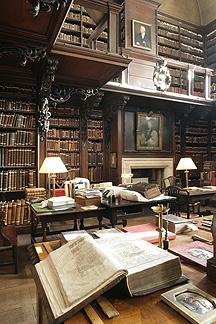
Under Mr. Wisdom's direction we entered the fantastic Cathedral Library. The Library is available for anyone who can make good use of it and had an interesting old book smell. The books are housed on two stories. The center of the library is open and a walkway winds around the upper story. Unfortunately, we were not able to go up as only two people are allowed up at a time due to structural problems.

The original collection was almost entirely destroyed in the Great Fire. Henry Compton (1632-1713), Bishop of London, donated 2,000 books to help rebuild the collection. Currently, the Library only collects works on Wren and the building of the Cathedral, the history of the Church in England, and "alumni" material. To manage and preserve the collection the Library employs a Senior Conservator, an Architectural Archivist, and a Collections Manager. Interestingly, until the mid-20th century, the librarians were in Holy Orders.

After the tour we were free to roam the Cathedral. Although I did not visit the Whispering Gallery, I wandered around the beautiful interior and visited the crypt, which is home to over 200 memorials.


Photos courtesy of the St.Paul's website.